I had quit from the Singapore flying Club end of 1991 when I came across an article in the Sunday Times advertising micro-light flying at Batu Pahat, Malaysia. The following Sunday morning I took the opportunity to ride my 400 cc Suzuki across the Johore Causeway heading for Batu Pahat, taking the Pekan Nanas road to Pontian. It was winding road like a snake until the west coast which then straightened out to run north to Senggerang a small town before the airstrip. Then another 5 kilometer to Tanjong Laboh where after enquiring from the local folks managed to find the airfield. The kampong folks were simple people friendly and very helpful.
On approaching the airfield I found two persons pushing a micro-light which apparently had broken down and followed them to the hanger. The person was none other than Mr Tay the resident flyer and early pioneer. I humbly introduced myself and in no time we were in conversation on our topic of flying. At that stage two other Singaporeans turned up in the hanger and immediately introduced as Rick and David Leong, they had come for the same reason. Obviously we had been bitten by the aviation bug and had suffered the same common over-powering infection, the urge to fly. Tay was most obliging and even not having to consider but straight away offered to train us for free. We only had to pay for the cost of the fuel and he provided the aircraft. Of course under one condition; you break it, you mend it. Oh! What a wonderful and un-expected surprise. We just could not believe as it turned out to be more than we had bargained for.
The occasion had been rather timely as he had all the time wanted to promote micro-light flying just as much as we wanted to fly. So we ended up in a sort of a win-win situation.
Firstly we had to do a medical check as required by the Department of Civil Aviation, Malaysia. We proceeded to town, found a reputable general practitioner who examined us and certified to be medically and physiologically fit to fly micro-light. The fees was only Rm15 . To think of it we were not only crazy but could be considered also stupid to fly a rag and tube machine without Insurance. Not only the micro-light had no certification by the manufacturer but also a warning caption clearly imprinted I think on the root-tube which read “ fly at your own risk” and so it was a big risk. Anyway our micro-light pilot’s licence came in April and it was simple in the form of a blue card. It should have remained as such simple and accessible as we were contented with our elementary or kindergarden “ flying. With that in hand we started to come every weekend for our flight training. Flying a micro-light was a wonderful experience especially in an open cock-pit, it was nearest to being a bird. Imagine you are floating high in the sky and looking down-wards to mother earth for a change. The urge to fly was as intoxicating as to consuming drugs, you get one shot and you are back for more.
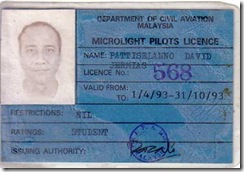
Micro-light Pilot’s Licence
The airstrip at Tanjong Laboh was a luxury in terms of landing distance and with a 1,800 ft runway. it was more than enough. Complete with runway boundary markers in orange/white/orange quartering were placed on either side of the runway at interval space of 100 ft apart. The width of the runway was also 100 ft. The comer marking the beginning and the end of runway are painted in white.

The circuit is an imaginary area in a form of a rectangular box above the airstrip raising from ground level to 500 ft where entry for joining or rejoining are made before descending to circuit height that is 200 ft. For information sake Tanjong Laboh is an un-control airstrip that means there were no DCA or their controlling agency. Flying was carried out at our own discretion. Keeping strictly to VFR (Visual Flight Rules) meaning “see and avoid” and flying under VMC (Visual Meteorological Condition) simply means good weather condition. For
joining or re-joining the procedure was that in-bound aircraft approaching the proximity of Tanjong Laboh to observe traffic pattern over the airstrip in order to determine the runway-in-use. To maintain 500 ft for the purpose of entry for joining or re-joining the circuit. May cross the airstrip runway from either side depending arrival direction. In case there is no traffic at all then it is obvious to check the windsock for direction and land into wind. Proper procedure would be to fly the minimum of 3 legs for the landing as follows.
1. Down-wind leg
2. Base-leg
3. Finals
Airfield specification:-
Identifier: WMAB (Whisky- Mike- Alfa-Bravo)
Location: Latitude; 01 degrees 44.7 mins N
Longtitude: 102 degrees 59.0 mins E
Runway heading: #15/33
Surface: laterite, semi-hard at center with grass at #33 end.
Navigational Aids: Batu Pahat NDB 330 degrees x 7.0 nautical miles from runway.
Traffic pattern : Left-hand circuit.
Cicuit height; 200 ft
Joining or re-joining; 500 ft.
Status of airfield: un-control
A micro-light trainer manufactured in Germany known as the “Skywalker” was made available for our training. According to Tay, it’s owner the 75 years old German named Whilhelm Gottschild had kindly left it behind. A dentist by profession he had gone to China to continue his career there.
The “Skywalker” basic construction was aluminum consisted of main tubular tube with 2 seats mounted in tandem in front with high wings supported by struts. The tail section made up of the horizontal stabilizer, elevator and the fin with the rudder... The seats doubled up also as fuel tanks. The power plant was a Rotex 532 water-cool engine of 65 hp mounted on the root tube and driving a 2 bladed wooden propeller. It had tri-cycle under-carriage with two main large wheels and a small nose-wheel. The construction was rather sturdy and robust
From the beginning I was not comfortable flying from an open cockpit especially in the early morning. The chill morning air battering your raw face continuously until to near numbness was somewhat not to my liking. The most frightening experience was landing as we had to descend much lower for micro-light and likely to freeze as the ground before you came rushing madly. And at that spur of the moment you ought to make the correct judgment to timely flare for a smooth touch down. If you are too early it will stall and slam to the ground and if too late it will bounce owing to excessive speed. I could not get over the landing speed as I found it to be a bit excessive for close comfort. Maybe the openness of the cockpit and the wind blowing my face had generated inside me this fear. Somehow I would prefer if the speed could be kept down much lower as I was a bit or maybe over cautious. A typical Singaporean with the “3 K’s syndrome” that “Kia Su –Kia See- Kia Bor “ interpreted as scared to lose, scared to die and scared of wife.

Tay with the “Skywalker” at Tanjong Laboh

Single-seat Aerodyne ‘Vector’ in flight
By early April 1993 we had news that another type of micro-light a much slower type Quick Silver MX II was available. The Flight Park under Pens Enterprise at Perlis had offered to sell one. Immediately we got in touch with Tengku Aznam to reserve for us as we would be going up the next day.

Tengku Aznam with author at Kangar, Perlis
Tay drove us via the main trunk road through Kuala Lumpur, Ipoh, Butterworth, Alor Star and finally to Kangar. It took us 12 grueling hours driving throughout the night and arriving in the wee hours of the morning. All of us were completely exhausted especially for our driver. At the Flight Park Tengku Aznam and the CFI Capt. Chung were there to greet us. We wasted no time and immediately got down to inspect Mx II and later tested by Tay before acceptance. We arranged with the mechanics to have it un-assembled and to truck it down by the next few days. When it did arrive at our airfield, we immediately set to work assembling the wings and tail-plane to the buggy. A few hours of flight tests were carried out to our satisfaction and finally accepted the aircraft as in good order.
Description of the Quick Silver Mx.II as follows:
The construction is aluminum tubing consist of main buggy, high wings supported by a king-post. The skin surface of the wings and tail-plane were of synthetic fabric. The power-plant was a Rotax (Austria) type 503 engine, a 2-cylinder 50 hp, single carburetor driving a 2-bladed wooden propeller at 6,200 rpm maximum power. The pusher engine hung inverted at the rear end of the root-tube with a 6.5 litre capacity fuel-tank at the forward end. The average consumption for dual is about 2.5 litre per hour. Seating arrangement is side-by-side with centralize control stick for student and instructor to share. So finally we had a reason to rejoice as we had a micro-light which suited best as a beginner’s plane and in which we were really pleased. We settled down seriously to our training, chalked up many enjoyable hours and found the characteristic of the aircraft, friendly and forgiving.
Jon had bought the “Tiara” a micro-light powered by a Rotex 532 of 65 hp driving a 3 bladed fixed pitch propeller. The fully enclosed cockpit with front windshield and side windows allowed excellent visibility. It had a “yoke” type control column like in a Cessna but it was a tail-dragger that means it had two big main wheels and a small tail-wheel. In the take-off run on attaining rotation speed, the tail will lift up first before the main wheels.
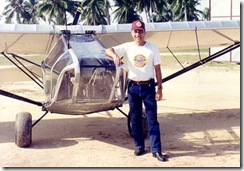
Author posing with Jon’s “Tiara T-bird”
He took me up once and we flew north towards the Batu Pahat town. I was really impressed with the performance, the flight was rather smooth and the controls sensitive. I could imagine myself being in the cockpit of a German Heinkel bomber with an un-obstructed all round view. Just imagining we are on our way to bomb the city of London. However on approaching a Chinese cemetery midway I was worried as I did not like the idea of flying over the cemetery. I felt guilty like many ‘eyes’ below were looking up at us for disrespectfully intruding their airspace. I could not help thinking that a sort of warning that went out. Something like hi! you guys don’t feel great, remember Newton’s law of gravity that what goes up must come down. So I indicated to Jon to avoid it and he happily did a left detour much to my relief. On our return we re-join the circuit for the landing. From the cockpit, the view through the Perspex was un-obstructed and very clear. The runway ahead appeared before us as Jon came in for the Finals. As he reduced power the Tiara came lower and lower with the ground rushing past below us before the main wheels touched the ground and rolled out. As the roll slowed down, the tail-wheel came down to touch the ground and Jon taxied slowly to his hanger. It was an enjoyable flight, one to be remembered.
Jon’s colleagues, Peter, Philip, Terry and Boy Mow Chau flew the “Vector” a micro-light with a unique “V” or also known “butterfly” tail... It was also so advanced for it’s time, the control mechanism could be change from 2-axis to 3-axis by merely pushing or pulling a button. However the disadvantage was that it had a single-seat. I had own one but never flew it as I was not confident in myself, so I allowed others to fly. I had bought to save it as it was no longer in use and laid discarded at a warehouse at Loyang, Singapore.
We also had this guy by the name of Williams, the “Birdman” and he flew a flexi-wing, a weight-shift contraption called the “Mosquito’ He would arrive at the airstrip in the morning with his dismantled trike loaded in the back of his station wagon. Then he would lay it out on the ground and start to assemble it.

William the “birdman” with his “Mosquito” powered hang-glider.
It was a hang-glider with a small motor attached behind driving a tiny propeller. The strange thing was that he had both hand holding the horizontal bar and the throttle mechanism was held between his teeth. He controls it by biting to exert pressure for acceleration or relax to release pressure for deceleration. However he had to gallop madly like a crazy horse to get into momentum before the lift-off. It was an unusual sight and everybody had focused on him in what appeared to be a dare-devil stunt. His run was a spectacular event like race watched by all especially for lift-off. He would gingerly fly away north to disappear from us, heading towards Batu Pahat town about 8 kilometers away. On returning, he would circle over-head until it ran out of fuel before gliding down gracefully to a perfect landing; always managed standing firmly on both feet like a professional. There was always a good size crowd of spectators gathered to applause him for his performance and for a safe return to mother earth. Anyway we admired and regarded him as our hero.
At that time we were a proud group of hard-core enthusiasts, a band of aviation crackpots like in the movie “ The magnificent men and their flying machines” Our machines were the “ the rags and tubes” type like in the early era and held together by bolts and nuts. There were wooden types kit-planes but these were not suitable to our “Tropical climate” due to humidity and also we did not intend taking any risk as the termites here at Batu Pahat has a great appetite for wood. Our covering was of fabrics, nylon, mylar or stits. I had designed a simple logo for our group and art-work for printing some “T” shirts in promoting the sports.

My fellow pilot Moo also flew a motorised Para-glider, a fun machine but limited to a short range owing to a small capacity fuel-tank. This is what Moo has to say in his own words:-
“On the morning of 23rdOctober 1995, I was at the breakfast table flipping the morning newspaper when an article with a photograph caught my attention. The article described a motorised Para-glider and how to fly it. After reading the article, I was fascinated by this strange flying machine and it’s simplicity to fly. I found out that this machine could be packed and loaded into the boot of a car after flying. And brought home instead of being parked in an aircraft hanger! After a few phone calls and the usual hassle of registration I was ready to undergo training
The morning of 24th October found me at the airfield at Tanjong Laboh , Batu Pahat. I was introduced to my instructor a pleasant Canadian named Francisco.The first lesson was how to haul the para-glider sail off the ground. To begin with the layout of the sail, checking all the strings and how to attach the sail to the harness correctly.
I practiced a number of times before I could sustain the sail above my head while running forward. It’s almost like flying a kite. When the sail starts to drop on the left side, I had to pull with my right hand to keep it upright. The trick was to counter any drop of the sail to the left or right and to keep it constantly to the centre in an airborne position so that the takeoff could be made in a straight path.

Francisco helps to pull-start
For the next lesson I was shown the engine with which I would be flying. It was a small, light-weight, two-stroke engine with a fixed-pitch propeller. I was taught how to strap-in and buckle-up. I also learned how to mix the fuel and fill the tank.
Finally I was ready for the actual flight and laid out the sail on the ground. With assistance I strapped into the harness with the engine at the back. An assistant attached the radio communication set on me and gave a test transmission. My instructor briefed me once more before take-off and asked me if I felt confident enough to fly. After all the lessons learnt on the ground, including knowledge of theory and my flying experience in micro-light I felt confident I could do it and told him so.
I stood with my hands gripping tightly at the controls and the leading edge lines as the engine Idled. With mounting excitement I waited for my instructor’s signal, as he checked the wind direction and the takeoff path. Finally he gave me the signal to takeoff.
I gave the Para-glider a tug and moved forward, I could feel the sail rise and “Bloom” above me. The next thing I remember was my instructor shouting over the radio “Power! Power! Run! Run! Run! “. As I ran balancing the open Para-glider above me, I squeezed the throttle to maximum and felt the tremendous thrust from the propeller pushing me forward.
I did not recall the number of steps I ran but before long my legs could not touch the ground. With elation I realized that I was airborne! I kept the throttle at maximum until I was about 200 feet above ground, when my instructor told me to ease off a little. I could feel that I was not climbing but flying level at a very slow speed probably 20 – 25 mph. I was then instructed to make a right-hand turn and fly level. The feeling was fantastic! I was actually flying the Motorized Para-glider! I tried to get into my seat but could not. I found out later that most new students have the similar problem.

Moo para-gliding at Batu Pahat
I was instructed to land by allowing the engine to idle and facing the wind. As I was about to touch the ground, my instructor told me to pull on both controls to act as a brake and bring the descend rate to a minimum. As I landed with just a few forward steps taken, my instructor, his assistant and a few senior pilots came to congratulate me.
It was a day to remember and I enjoyed it tremendously. I had flown a motorized Para-glider successfully ! Since that day I have flown more than 45 hours in a motorized Para-glider and have enjoyed every minute of it. Owing to it’s slow speed you have all the time to enjoy the scenery from above. Unlike aircraft which was faster and I would recommend it to anyone who is keen to fly.”
By the third quarter of 1994 we had grown in numbers and in aircraft to a sizable group. We were ready to host our first “Fly-in” function to be held between the 28th to the 30th October.
So we begun in earnest to get things organized with Jon sending out invitations to the various flying clubs in Malaysia, Singapore, the Polis Air Wing and some other organizations. We stated our main objectives were:-
a) promote recreational flying particularly in micro-light
b) increase the level of air-mindedness amongst the general public especially in our Johore region.
c) offer to the pilots the experience of flying to new destinations.
d) improve the airstrip and facilities available at Tanjong Laboh by stepping up current usage.
e) hold the Inaugural Meeting of the “Experimental Aircraft Association, Malaysian Chapter to be held at the hotel.
Our runway had been recently received some maintenance with the grass being cut by JKR and the markers being re-painted or re-placed. Two new poles with windsocks were installed one at Jon’s hanger and the other at our end. Other matters concerning transportation, hotel accommodation, refueling for aircraft fell upon Tay who had deputized others to assist.
Basically our programmed had been centered on micro-light and flying times allocated in the morning and evening when winds are mild. On the first day the 28th October the airfield was opened for arrival aircraft. Unfortunately the “haze” came in caused by irresponsible “slash and burn” methods practiced by the Indonesian farmers. It was so bad that it had blanketed the whole region with smog. You could even smell the burned wood as it filled the atmosphere. Many participants just had to cancel their trip as it posed as a great navigational hazard. Especially for the micro-light as they flew by visual flight rules that is by vision, see and avoid. Only two participants came through, one was the Polis Air Wing with their Pilatus turbo-porter and Capt. Morgan from Singapore in his Cessna 172. Any way the show had to go on and we as resident flyers had sufficient aircraft to do so. Some participants showed up but without aircraft. Tengku Aznam came down from Perlis and Capt. Siva from Kuala Lumpur.
Day 2 the 29th October, Saturday the micro-light dominated the morning flying the “Young Eagles”. A programmed design to give joy ride especially to the youth, to encourage and instill into them the flight of air experience. Then followed by a demonstration flight by the Polis

Left to right: Wee, Isa, Paul, Najib, Author, Capt.Siva and Tay.
Air Wing turbo-porter single engine aircraft. It had super short take-off and landing capabilities and able to operate from short or improvised airstrip.
The Inaugural Meeting for the Experimental Aircraft Association, Malaysian Chapter was held at the hotel in Batu Pahat town.

Aircraft on display at Tanjong Laboh airstrip.
Day 3 (30th October) Sunday. As usual the micro-light dominated the morning sky continues flying the “Young Eagles” and that was followed by presentation of prizes and certificates.
Finally the curtains came down with the closing ceremony and the aircraft leaving for home.

Capt. Morgan with 2 Young Eagles Ian and Arlene displaying their certificates
Some time later there had been some mishaps at the airstrip and one unfortunate accident happened to me; it was the case of a runaway plane. One weekend I was at the airstrip and we had a number of guests from Singapore. The worst part was that my “Challenger” plane could not start and I could not figure it out why. The battery was still strong and I did not think that was the reason. It could be the carburetors as the flow of fuel seemed to be not sufficient enough to spark on the engine. Anyway it would require two persons to work it out but on that busy morning everybody had taken to the sky. So I thought that I would have to do it by myself, that decision was sheer stupidity. The reason was that there was no “helper” around and that I had no choice.
I had the “Challenger” properly tied down by port and starboard wings to concrete ballast weights each on either side. The under-slung Rotax engine hung at the rear of the root-tube and acted as a “pusher” common in micro-light. So I figure out a solution that I would have to “on” the carburetor chokes by depressing it, advance the throttle a bit for more flow of fuel and “hit” the ignition button. All this had to be done from the portside where the chokes are located and the throttle at the left side of the cockpit. The “Challenger” has enclosed cockpit with windows on either sides. Normally for easy entry and exit is done from the starboard side as there was no obstruction. On the portside the throttle set-up was in the way with the lever protruding out. For safety reason my “electric starter” was hidden behind the Instrument panel at the lower end to prevent “accidental ignition”. From experience we learned that during static displays at “Fly-in’ location, many inquisitive visitors would get into the cockpit and fiddle with the instruments. Imagine what would happen if someone push-start accidentally with a crowd milling around the aircraft. The spinning propeller could have easily cut somebody that stood in the way.
So I went to the engine and “on” the chokes and then to the cockpit, lift up the window to advance the throttle and “hit” the ignition button. The engine burst into life with the propeller spinning a few turns and died off. I walked back to the engine gave the chokes a few pumps and got back to the cockpit. Lifted up the window and advanced the throttle much more.
The engine burst into life with a mighty roar that motioned the aircraft forward with force. I found that it was pushing me and I held and lean on to the nose cone in an attempt to hold back. The force was great and I was losing grip, at that moment I slipped and fell under. The “Challenger” ran over me, dragging the 2 ballast weights along. It went forward and hit Tay’s
Quick Silver GT 500, swayed to the left and went on to hit stationery Mx II micro-light before stopping. There was a woman in that aircraft at that time but no harm befell upon her. Fortunately the “Challenger” had the engine mounted at the rear as a “pusher” as in most micro-light at Tanjong Laboh. Had it a front “traction” engine the spinning propeller would have chewed the GT 500 into shreds. I sustained only minor superficial injuries and an unforgettable lesson to remember. I had to “make good” the repairs of the GT 500 by replacing the

The revenge of the runaway “Challenger’
Perspex for the front wind-shield. Luckily the replacement could be obtained from a factory called “Cadillac Plastic” in Singapore.
We held another EAA “Fly-in” in 1996 on the 26th – 27th October at Tanjong Laboh. It was organized by EAA 1090 our Malaysian Chapter and the Committee comprised the following:
Chairman: Inche Rahim (Manager DCA Johore)
Vice-chairman: Capt. Siva
Hon. Secretary: Pattiselanno David (Author)
Hon: Treasurer: Inche Isa
Club Captain: Mr.Tay
Ordinary Members: 6 members were Jeyapaul, Wee, Leon, Najib, Hamzah and our Monty.
For the two day event the airfield was opened on the 26th from 1000 hours for participating aircraft from other States to fly in. At about 1600 hours the airfield was temporary closed for the Ceremony to kick off. Our ultimate aim was:-
1. Generally to promote Aviation in support of Prime Minister Dr. Mahathir’s drive for
advancement in aerospace industry.
2. To introduce and encourage micro-light flying in particular, including flexi-wing, powered
parachutes and para-gliding.
3. To instill the sense of air-mindedness amongst the youth in participating in our “Young
Eagle’s programme.
4. To promote “Goodwill and fellowship” amongst all our flyers.
5. To promote the use of our Tanjong Laboh airstrip.
Other arrangements were made to house the meetings and guests at the Crystal Inn and Hotel Novo Park in town. Capt. Siva with partner flew in with their RV 6 Aircraft and also Bala from Singapore dropped in his red Piper Tri-pacer with some Japanese students.


Capt. Siva with his RV 6 Bala with his Japanese students
From 1730 to 1900 hours we launched the “Young Eagle’s” programmed taking the young up for the first time of the life. It was a terrific experience for them to have the opportunity to be airborne. There was team display of paragliding by Eric Lee of Air Freedom. Finally a welcome dinner was held at the Hotel Novo Park.
The next day 27th October Sunday morning the organization arranged a Treasure hunt for the micro-light first and the afternoon the GA aircraft turn. The aero-model enthusiasts took over and displayed their skills with their aerobatic maneuvers. After lunch we had prize giving and the closing ceremony. At 1400 hours saw the departure of GA aircraft and it had been a
successful event.
The year 1997 saw a lot of improvement under Asia Sports, there came additional Mx’s and setting up three 40 ft containers to provide a class-room, main administration, CFI offices and store. A specially designed control tower was made and mounted on the top of the first container. It was painted in cream to brighten up and improve the surrounding; it also became an impressive landmark in the kampong. We had a flag signal pole erected at the tower and flew the following flags as signal, the “yellow” flag to denote that the airstrip is operational and in use, the red to indicate “danger” do not land as an accident had taken place at the runway and finally “green” to denote “all clear”.

In 1997 a “New look Tanjong Laboh”
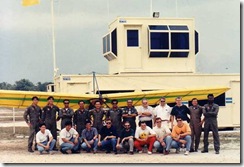
Micro-light Group at Tanjong Laboh

Our container office

Left to right: Author, Norman, Moo and Capt, Chung
Also that year was marred by an accident involving Bill’s unfortunate force landing into a pond that featured in the Chinese press. Eventually he had to give a account of the incident to the DCA, Kuala Lumpur. His story was that he had purchased 2 second-hand micro-light aircraft type “Bantam B-22” and “B-20” of New Zealand manufacture. When the micro-light arrived, Bill and his son Steve started to assemble them. As for the paper work and the de-registration documents according to Bill was on the way from New Zealand.
On the 24th and the 31st of August, he had one hour of high-speed taxi runs and “crow-hops. The “crow-hops” are practices involved taking the plane up at one end of the runway and putting her down by the other end. The evaluation was to enable the pilot to feel and assess the responses of the controls. He said that he had been told that since he had soloed and had assembled the aircraft himself, he could test fly to check it out. He was in the opinion that all the checking and testing could be done prior to registration of the aircraft.
He did a test flight of 30 minutes on the 31st August to check the adjusted trim. In the process he found that he needed 6,000 rpm to maintain level flight with a full trim. Incidentally there was a slight crosswind from the left side near two-thirds distance of the runway where there was a small hill that generated rotor turbulence that swept across. He had climbed to about 200 ft, started a gentle left turn into wind before the hill when the engine started losing power rapidly. In a matter of 3 – 4 seconds it went from 6,000 rpm to 3,000. The plane had a “Clark Y” airfoil and thus did not have the gliding characteristics like a Quick Silver Mx. There was no place for him to land although he did have sufficient altitude to make it back to the runway. He faced 3 options.
1. Crash into the trees.
2. Crash into the hangers
3. Crash into the pond.
He chose the third option and that had proved to be the best as he did not suffer any injury; just a “sore back”. However he was not aware of any requirement pertaining to reporting the matter. The emphasis in repeated discussions about micro-light was from the time of take-off to always be “prepare for an engine failure”. Engine failures in micro-light are very common occurrence and followed by subsequent force landings. It was generally accepted and not totally un-expected dilemma. He did not think it was un-usual enough to get excited about.
Anyway after an inspection, he had discovered that the cause of the engine failure was due to a crack at the welding seam at the exhaust. The opening was about 9 mm and that resulted in the subsequent loss of power.
The Rotex engines rely on the design of the exhaust to scavenge the burned gases from the combustion chamber. When the system cannot perform it’s designed function the engine looses power. The fact is that you cannot start the engine without the exhaust being connected.

Bill Cooke’s 2-place “Bantam”micro-light
There were unfounded rumours circulating around that we at Batu Pahat were “bandits of the air” flying recklessly without conforming to rules. The rumours were malicious, irresponsible and spread by person or persons with intend to damage our reputation. I believed that all the fliers at Batu Pahat were properly screened before being issued with licenses. And our aircraft are registered accordingly as required by the Department of Civil Aviation. Our objectives and purpose are simple to enjoy flying as a recreational sport. We are weekend fliers wanting to promote micro-light flying in particular and aviation in general. We also wanted to encourage people especially the young to fly. Flight training are based on recognised training manual” as issued by the manufacturer of the aircraft that we used. There were no serious accident or casualty during our time as safety standard had been our concerned. The situation greatly improved with introduction of radio communication. Later on we even added a control tower with the relevant flag signals as additional avenues for safety. Above that we also had a rescue boat complete with scuba gear made available in the event of ditching at sea. Obviously it was plain jealousy just out to destroy us; it was part of politics that was going on at that time.


 Posts
Posts

